

Global Cosmetic Safety - How CPSR Supports EU Compliance and US MoCRA Readiness
The global cosmetics industry is evolving rapidly, alongside increasingly robust regulatory expectations. Cosmetic brands are expected to do more than develop innovative formulations; they must demonstrate product safety through scientifically sound documentation that withstands regulatory scrutiny.
In the European Union, this requirement is formalized through Regulation (EC) No 1223/2009, which mandates a Cosmetic Product Safety Report (CPSR) before a product is placed on the market. In parallel, regulatory developments in the United States under Modernization of Cosmetics Regulation Act (MoCRA) have reinforced the need for documented safety substantiation throughout the product lifecycle.
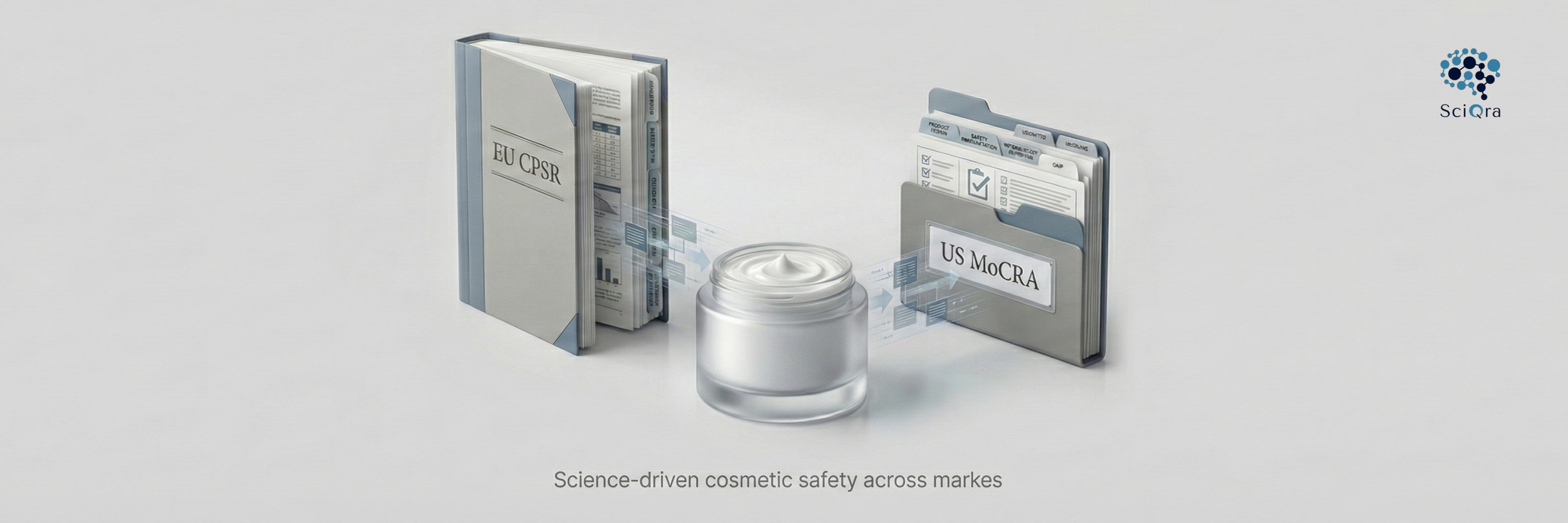
CPSR Requirements Under EU Regulation 1223/2009
According to Regulation (EC) No 1223/2009, every cosmetic product placed on the EU market must be supported by a Cosmetic Product Safety Report (CPSR), which forms a core component of the Product Information File (PIF). The CPSR provides the scientific justification that a product is safe for human health under normal and reasonably foreseeable conditions of use.
The CPSR consists of two parts: Part A (Cosmetic Product Safety Information) and Part B (Cosmetic Product Safety Assessment). Together, these components evaluate key safety aspects, including:
The cosmetic ingredients present in the formulation and their toxicological profiles
The product formulation and intended use
Consumer exposure levels
Potential health risks
The overall product safety conclusion
The CPSR is a mandatory regulatory requirement. Without a valid CPSR, a cosmetic product cannot be legally placed on the EU market.
MoCRA: How US Cosmetic Safety Expectations Are Evolving
The Modernization of Cosmetics Regulation Act (MoCRA) represents the most significant update to US cosmetic regulation in decades. MoCRA strengthens FDA’s authority and reinforces expectation that cosmetic products placed on the US market must be adequately substantiated for safety.
Key points under MoCRA include:
Safety substantiation: Manufacturers must ensure that cosmetic products are safe under normal and reasonably foreseeable conditions of use.
Ingredient evaluation: Consider toxicological profiles, potential hazards, and cumulative exposure of ingredients.
Record keeping: Companies must maintain records substantiating product safety, including formulation details, ingredient information, and exposure assessments. Records must be available for FDA review, when required.
Fragrance Allergen Labelling Requirements
Mandatory Recall Authority: FDA can initiate recalls if products are found unsafe.
While MoCRA differs from the EU CPSR framework, it clearly signals that undocumented safety assumptions are no longer acceptable, and that risk-based, evidence-driven safety assessment is now expected for all US cosmetic products.
Benefits of a Science-Driven, Harmonized Safety Approach
Adopting a strategy that aligns EU CPSR practices with MoCRA requirements offers tangible benefits for cosmetic brands:
Key Benefits:
Regulatory Readiness: Minimizes risk of non-compliance in multiple markets by ensuring safety documentation meets both EU and US expectations.
Efficiency: Leverages existing EU CPSR data, reducing redundant testing, documentation, and resource use.
Evidence-Based Confidence: Provides a scientifically justified foundation for ingredient safety, formulation decisions, and product labeling.
Proactive Risk Management: Identifies gaps early, including state-level restrictions, ensuring smoother market entry in the US.
Audit and Inspection Preparedness: Consolidated documentation supports audits, inspections, and regulatory inquiries in both regions.
Consumer Safety Assurance: Enhances trust in product safety through rigorous, lifecycle-based safety substantiation.
A harmonized, science-driven approach not only ensures compliance but also strengthens product development, market strategy, and consumer confidence - turning regulatory requirements into a strategic advantage.
Can a CPSR Support MoCRA Compliance?
An existing EU Cosmetic Product Safety Report (CPSR) can support MoCRA safety substantiation, but it does not automatically ensure US compliance.
A well-prepared CPSR contains much of the scientific foundation expected under MoCRA including:
Full qualitative and quantitative formulation
Ingredient-level toxicological evaluation, including hazard identification and dose-based reasoning
Exposure assessment based on product use and type
Weight-of-evidence safety conclusions for the finished cosmetic product
Consideration of normal and reasonably foreseeable conditions of use
However, a CPSR is developed specifically to demonstrate compliance with EU Regulation (EC) No 1223/2009, not US federal or state law. Key gaps typically include:
Product classification differences
Products classified as cosmetics in the EU may be regulated differently in the US. Certain claims or product functions may classify a product outside the cosmetic category in the US, triggering additional regulatory obligations beyond MoCRA.
US-specific ingredient restrictions or prohibitions
Ingredients permitted or restricted under EU Annexes may be subject to different limits, prohibitions, or conditions of use under US law.
Color additive regulations
The US requires color additives to be FDA-approved and, in many cases, batch-certified. CPSRs do not assess compliance with US color additive approval or certification requirements.
State-level compliance considerations (e.g., California Prop 65, PFAS bans)
Documentation framing, as MoCRA does not mandate a CPSR-style report, but expects safety substantiation to be clearly documented, traceable, and inspection-ready
In practice, a CPSR should be viewed as a technical backbone, not a substitute for US compliance. MoCRA safety substantiation is best achieved by leveraging CPSR data while conducting a targeted US regulatory gap assessment, particularly for product classification, ingredient status, and labeling implications.
How SciQra Supports CPSR Preparation and Compliance
Navigating EU and US cosmetic safety requirements demands more than compliance checklists. SciQra provides targeted, science-driven support to help brands harmonize their safety assessments and ensure defensible compliance:
Bridging EU and US Requirements
Leverage existing CPSRs as a foundation while identifying and addressing US-specific gaps, including ingredient restrictions, colorant approvals, and state-level regulations.
Gap Analysis & Regulatory Strategy
Pinpoint areas where EU safety data does not automatically meet MoCRA expectations and develop a clear, documented plan to achieve compliance.
Integrated Safety Strategy
Align CPSR data with MoCRA expectations, bridging EU toxicological assessments and US-specific gaps.
Toxicological Evaluation of Ingredients and Formulations
Conduct hazard identification, dose-based reasoning, and exposure assessments for raw materials and finished products.
Documentation & Traceability
Prepare inspection-ready, scientifically justified reports that support both EU PIF/CPSR and US safety substantiation requirements.
Lifecycle Compliance Support
Update safety assessments in response to formulation changes, supplier updates, or evolving regulations, ensuring ongoing defensible compliance.
By combining scientific rigor with regulatory foresight, SciQra helps brands to confidently align their safety strategies across jurisdictions, turning regulatory challenges into a strategic advantage while ensuring robust EU and FDA compliance.
Frequently Asked Questions
Is a CPSR mandatory for all cosmetic products?
Yes. Any cosmetic product placed on the EU market must have a CPSR. It is more than compliance; it’s a scientific demonstration that the product is safe under normal and foreseeable conditions of use.
Does a CPSR cover natural and organic cosmetics?
Yes. Natural or organic ingredients are not automatically safe regulators require the same level of rigorous safety evaluation.
How often should a CPSR be updated?
A CPSR is a living document. It should be updated whenever there is a formulation change, regulatory update, new toxicological data, or change in intended use. Proactive updates help avoid compliance risks, ensure that cumulative exposure is always accurately assessed, and maintain alignment with evolving EU and international regulations.
How should brands approach cross-market safety alignment?
Brands should not assume that a CPSR automatically ensures global compliance. Instead, it should be used as a strategic, harmonized foundation. By mapping EU CPSR data against US requirements, identifying gaps, and documenting risk-based reasoning, companies can create a robust, inspection-ready safety dossier that serves multiple markets while minimizing duplication of effort.
